
Hyundai has invested $1.8 billion in India.

Tucson is slated to be launched later this year

Fuel price hike will impact demand going forward.

Automakers in India posted their worst growth in recent times in May 2011.

Fada estimates that global supply chain headwinds like scarce availability of rare earth elements for electric vehicle components and geopolitical tensions may affect urban consumer sentiment in June as well.
The New Year will begin on a costly note for car buyers with major players, including Maruti Suzuki, Hyundai Motors and General Motors, planning to increase prices of the vehicles by as much as Rs 12,000.
General Motors, Nissan Motor India and Volkswagen managed to ride the tide with new launches.

All the three companies that made their stock market debut on Wednesday delivered huge day-one gains for investors. Shares of digital payment major One Mobikwik Systems surged 90 per cent, while that of fashion retailer Vishal Mega Mart and pharma firm Sai Life Sciences gained around 40 per cent each. These stellar debuts came despite the benchmark indices logging continuous declines since their initial public offerings (IPOs) closed on Friday.

Retail sales of electric passenger vehicles (ePVs) nearly doubled in July 2025, surging 93 per cent year-on-year (Y-o-Y) to 15,528 units, even as overall passenger vehicle (PV) retail volumes declined marginally. In contrast, electric two-wheeler (e2W) sales dropped by 4.3 per cent to 102,973 units, according to the Federation of Automobile Dealers Associations (Fada) data.
The new line-up will be supported by a 360-degree marketing campaign touting 'I live the uber life'.

Indian automakers are reviving legacy nameplates to leverage brand recall and stand out in a crowded market, as classic badges like Sierra, Safari, Baleno and Scorpio return to attract buyers.

Recently, TPEM's first born electric concept, Avinya broke cover. The model promises a minimum range of 500 kilometres and advanced technology features, aimed at buyers in India and outside. TPEM, the newly formed entity may also consider a separate dedicated sales channel for the EVs with a distinctive corporate identity once the volumes reach a critical mass and throughput is large enough for the dealers to be profitable, said Chandra. Elaborating further on the hiring strategy he said, "We will hire from everywhere-wherever the talent of the required competency is available."
International automakers have supported the Hyundai Motor's demand for a two-year notice period before any changes are made by the Indian government with regard to excise or custom duties for the auto sector.

Tata Motors is looking at various measures, including direct buying from stockists and making changes in the product configurations, to offset the impact of semiconductor shortage on its production activities and sales, a top company official has said. The auto major, which sells models including Nexon, Harrier and Safari in the domestic market, is also looking at different kinds of chips which could be used in components where the supply situation is severe. The automaker expects the situation to remain challenging in the ongoing quarter and some improvement in supplies only in the second half of the fiscal.

Union Minister Nitin Gadkari on Tuesday launched the country's first crash testing programme Bharat NCAP aimed at improving road safety standards of motor vehicles up to 3.5 tonnes. Bharat New Car Assessment Programme (Bharat NCAP) is India's own crash testing programme and is cheaper than tests conducted abroad, Gadkari said, adding that the star ratings will help buyers understand the quality of the product and make an informed purchase decision. Bharat NCAP will be implemented from October 1, 2023.

Leading carmakers Maruti Suzuki and Hyundai witnessed a double-digit drop in sales in October on account of the global semiconductor shortage impacting production. Kia India, Honda Cars and MG Motor also saw a fall in dispatches last month as compared with October 2020. However, companies like Tata Motors, Mahindra, Nissan and Skoda managed to post positive numbers last month despite the supply chain challenges.
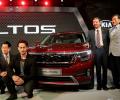
What explains India's love affair with SUVs? They are not exactly "value for money" -- the watchword for brands across segments -- nor always practical. Is it for the badge value? Or the butch imagery associated with SUVs? Maybe both, says Alokananda Chakraborty.

Net flows from domestic institutional investors crossed Rs 5 trillion for the first time during a calendar year.

'We deeply apologise for a post that was published on some KFC social media channels outside the country. We honour and respect India, and remain steadfast in our commitment to serving all Indians with pride,' according to a message on KFC India official account on Twitter.

'We don't have to compete with Maharashtra or Gujarat. We have to now start thinking about how we compete with the United States or China.'

Recently, South Korean Foreign Minister, Chung Eui-yong, dialled his Indian counterpart, S Jaishankar, in New Delhi. His government, he said, "regretted the offence caused to the people of India". A day earlier, India had summoned the South Korean ambassador to express its "strong displeasure" over "an unacceptable social media post".
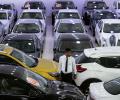
Prices of various car models -- ranging from entry-level hatchbacks to high-end luxury offerings -- are set to rise as automakers have announced price hikes with effect from January. Carmakers cite an increase in input costs and operational expenses as the main reason to implement price increases from the next month. Industry experts, however, note that the exercise is also undertaken by automakers every year in December to shore up sales volume in the last month of the year, as customers postpone buyouts to later months to get the new year manufactured units.
Hyundai Motor India Ltd, the country's second-largest carmaker, launched a new-look version of its Santro compact car on Thursday and said the model will help more than triple exports this financial year.\n\n

Seven manufacturers together post a 15% decli#8800 M&M, Ford and Honda buck trend.

Fifteen companies have launched their initial public offerings (IPOs) in December 2024, making it the best month for public offerings since 1996. Collectively, they have raised Rs 25,425 crore, which also made December the best month in terms of the quantum of funds raised. In December 1996, 33 companies had raised Rs 931 crore.
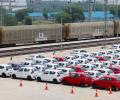
Companies with "gas guzzlers" are trying to set up the wrong narrative against small cars getting relaxation in the proposed corporate average fuel efficiency (CAFE-III) norms on the basis of weight, Maruti Suzuki senior executive officer corporate affairs Rahul Bharti said on Monday, bringing to the fore deep division among carmakers regarding the upcoming rules.

Leading automakers Maruti Suzuki India, Hyundai and Tata Motors reported a double-digit increase in dispatches to dealers in April as the demand remained robust especially for the sports utility vehicles. The country's largest car maker Maruti Suzuki India (MSI) said its domestic passenger vehicle wholesales rose 13 per cent to 137,320 units last month as against 121,995 units in April 2022. Sales of mini cars, comprising Alto and S-Presso, fell 18 per cent to 14,110 units as compared with 17,137 units a year ago.

While Hyundai Motor India reported a marginal growth, Toyota Kirloskar Motor witnessed a dip in sales last month.

India's flagship motor show Auto Expo 2023 kicked off on Wednesday with the global unveiling of Suzuki Motor Corporation's concept electric SUV 'eVX' which is slated to hit the market by 2025. The company's Indian arm Maruti Suzuki India is among the major manufacturers participating in the show that has returned after three years. The Concept eVX is a mid-size electric SUV concept designed and developed by Suzuki Motor Corporation (SMC), Japan. It will be powered by a 60 kWh battery pack offering up to 550 km of driving range on single charge.
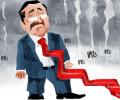
For investors who missed the initial IPO frenzy, the market correction is an opportunity to selectively invest in promising names, but patience and careful evaluation remain the key.

Hyundai Motors on Wednesday enhanced its product portfolio in India by bringing in Tucson, its latest sports utility vehicle.

This number is more than the total number (1,071) of electric cars sold in India in calendar year 2019. MG has stopped registrations for the ZS and will cater to 2,409 of the total bookings.

Major carmakers, including Maruti Suzuki, Hyundai, Tata Motors on Friday reported growth in their passenger vehicle sales in June as semiconductor shortage woes showed gradual signs of easing out. Other manufacturers, Kia India, MG Motor India and Skoda Auto India also reported robust sales growth last month. Maruti Suzuki India (MSI) reported 5.7 per cent increase in total wholesales at 1,55,857 units in June as compared to 1,47,368 units to dealers in June 2021.
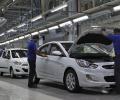
Domestic passenger vehicles sales rose by 23 per cent to a record of 37.93 lakh units in 2022 led by the likes of Maruti Suzuki, Hyundai and Tata Motors as the companies rode on easing of pandemic related challenges and semiconductor shortages to cash in on pent up demand, specially for SUVs. Other manufacturers like Toyota Kirloskar Motor and Skoda India also reported record sales in 2022. "The industry wholesales in January to December 2022 were just short of 38 lakh units.

Hyundai Motor India Ltd (HMIL) on Thursday said it will hike prices by up to Rs 20,000 across models, except the newly launched compact car Grand i10, from October 1 to offset the impact of rupee depreciation and rising input costs.

The company, whose arm Maruti Suzuki is the largest passenger vehicles maker in India, asserted that it does not align with any political or religious inclination in any part of the world.
The strike, however, had no impact on production of auto majors Maruti Suzuki India, Hero MotoCorp, Honda Cars India, Mahindra & Mahindra, Tata Motors and Hyundai Motors India as their plants in various parts of the country functioned normally.
Multiple tailwinds for the automobile sector, including a cut in goods and services tax (GST) rates, are keeping analysts bullish on auto stocks from a long-term perspective, even as they see the rally running its course in the near term.
Passenger vehicle wholesales in India increased 4 per cent year-on-year in May to 3,47,492 units, as compared to the same month last year, industry body SIAM said on Tuesday. Overall passenger vehicle (PV) dispatches from companies to dealers stood at 334,537 units in May 2023.
